Built for sites that take security seriously.
Encryption at rest and in transit. Certificate-based device auth. Signed firmware. Secure boot. Audit logging on changes and sensitive-record access. Mapped to the procurement frameworks enterprise buyers commonly ask for.
A gate that never blinks, never forgets, and logs every pass.
A guard blinks, tires, and goes off-shift; a clipboard gets a plate wrong. GateGuardX reads every vehicle that reaches your gate, day or night, and keeps a perfect record of it. Not to replace your team, but to give them a tireless second set of eyes and a memory that never fades.
It reads every vehicle that arrives
Around 200 frames per pass, so it catches the dirty, bent, and off-angle plates a single glance misses. A 99.9% read rate across our live sites, in rain, dust, glare, and the dark.
It forgets nothing
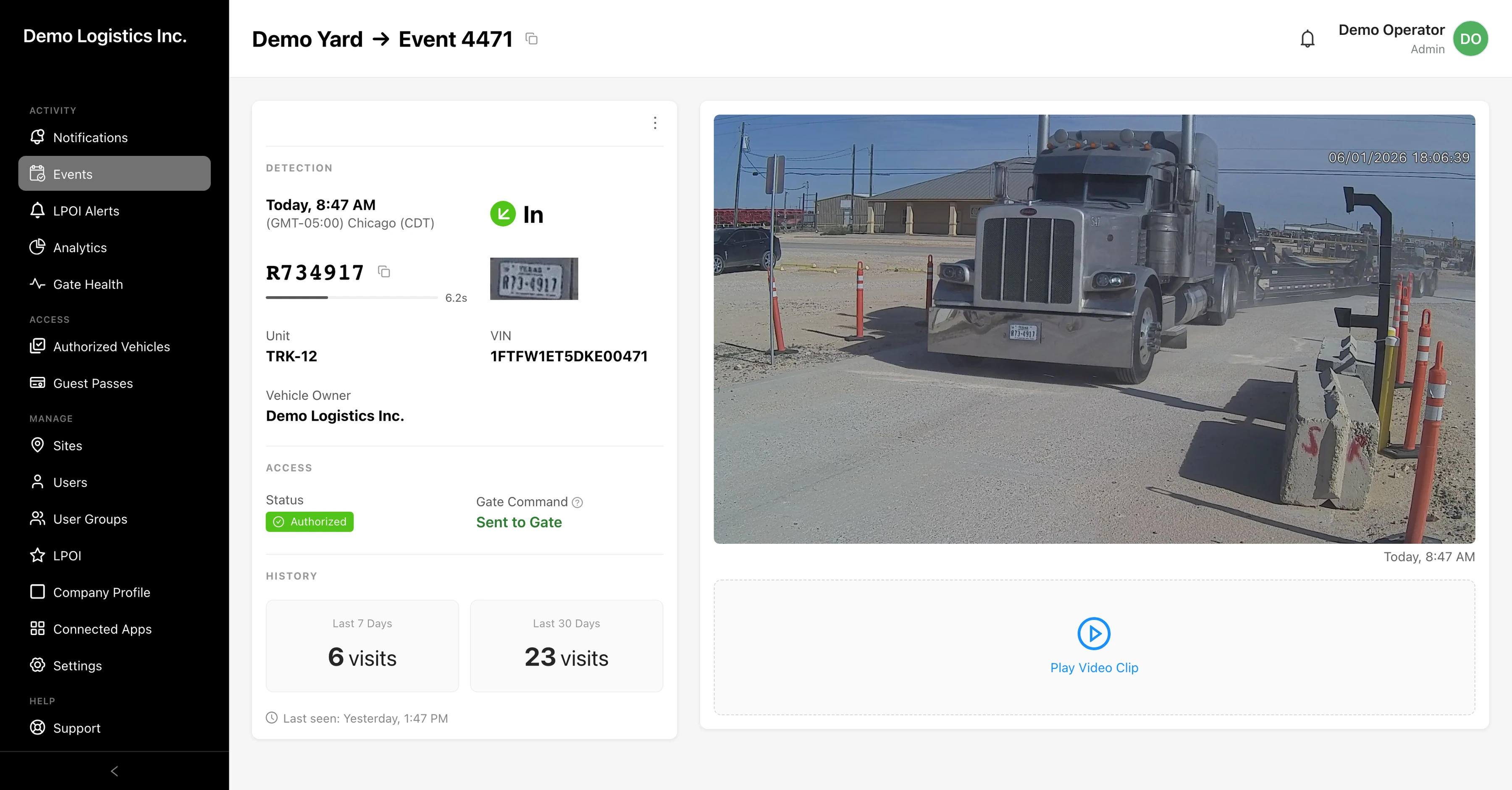
Every crossing is kept: plate, full vehicle photo, and a short clip. Each plate's past visits sit right on its record. The log a guard used to keep by hand, now kept automatically, and exactly.
It knows your list cold
Plates you've authorized open in under a second, the same rule every time. Everything else stays shut, gets screened against your rules, and is logged either way. It never opens on a guess.
It augments your security team; it doesn't replace the people who watch your site. What it removes is the tedium a person can't win against: the missed plate, the illegible logbook, the 3 a.m. lull when attention drifts.
Every crossing is an auditable record.
Plate, photo, and a short clip, encrypted, retained on your schedule, visible only to the people you authorize, and logged whenever anyone opens it.
Your gate, your data, not a surveillance network.
Some plate readers feed a shared network that pools and trades vehicle sightings across cities, which is exactly what's driving the public and legal backlash against them. GateGuardX is the opposite: a plate is matched against your own allowlist, on your site, the gate opens, and the record stays yours, retained on your schedule, visible only to the people you authorize, and never pooled into a shared network.
It's a deliberate design choice: your access data exists to run your gate, not to populate someone else's database. That keeps your exposure low, and the trust of the people who pass through your gate intact.
From critical infrastructure to privacy-sensitive communities.
- Regulated & critical infrastructure, energy, utilities, transportation, and industrial sites under compliance mandates.
- Government & defense contractors, CUI handling aligned to NIST SP 800-171, with GovCloud hosting on request.
- Privacy-sensitive communities, HOAs and residential sites that want controlled access without a surveillance network.
- Multi-site enterprises, one security policy, role-based access, and audit-ready exports across the portfolio.
Cybersecurity Framework, current alignment.
Controls for CUI handling, where relevant.
Controls aligned to the standard.
Controls aligned to the framework.
Privacy controls + DSAR workflow available.
AWS GovCloud and Azure Government hosting on request.
The default settings cover what most procurement audits ask for.
- AES-256 at rest, TLS 1.2+ in transit (the encryption standard security teams look for in audits)
- Certificate-based device auth
- Signed firmware + secure boot
- Audit logging on changes and sensitive-record access
- Role-based access control
- Plate-data retention controls
- Where is our data stored?
- Recognition and gate control run on the local edge device, and the camera's raw footage stays at your site. Event records — plate, photos, clip — sync to your dashboard. Further cloud features are enabled per site; private-cloud and AWS GovCloud / Azure Government hosting are available on request.
- Can it run without the cloud?
- Yes — for up to 30 days fully local, with no event upload. Plate reading and gate control run locally, so gates keep opening from a saved copy of your approved list even with no connection, and records upload once it's back. The internet is never required to open a gate. The one exception: the optional Conversational AI voice agent (beta) uses cloud-based speech processing when you turn it on, and if that's unreachable, the gate simply falls back to your keypad, intercom, or remotes.
- Do you sell or share access data?
- Never. A plate is matched against your own allowlist, on your site, and the record stays yours — it is never pooled into a shared vehicle-sighting network. Your access data exists to run your gate, nothing else.
- Who can see plate data, and how long is it kept?
- Only the people you authorize, under role-based access; access to sensitive records (accounts, events, vehicles, reports, settings) is logged. Retention is configurable per site, and deletion and data-subject requests run through the CCPA / GDPR DSAR workflow.
- Are the cameras NDAA-compliant?
- Yes, the plate-reading (LPR) cameras supplied in our kit meet U.S. federal security rules (NDAA — cameras built in approved countries). If a deployment reuses your existing cameras, we verify their NDAA status during the compatibility check (required for government-linked sites). Firmware is signed with secure boot and devices authenticate with certificates, so only trusted hardware joins your network.
- Can we get a DPA and your security documentation?
- Yes. A DPA is available, along with our control summary and framework alignment (NIST CSF, SP 800-53 / 800-171). We'll share the full security package and work through your security questionnaire under NDA during evaluation.
Put audit-ready access on your gate.
Send a few photos of your gate and your compliance needs, and we'll confirm compatibility and send a detailed quote, usually within 2 business days. Security or procurement team? Ask for our DPA and security package.
- 30-day money-back guarantee
- 1-year hardware warranty
- No gate replacement
- Compatibility answer in 2 business days